The previous article in this series, Two GTM Battles, showed that B2B companies compete twice. First they have to win the shortlist and early preference, and then they have to become the vendor the whole buying group chooses. That leads to a practical question about what a company needs to build to compete in both.
Authority signals are the public evidence buyers and AI systems use to judge whether a company is credible. HiFuture’s Authority Signals Model™ sorts them into three groups. Company Authority Signals show what the organisation knows and proves, Human Authority Signals show who demonstrates that expertise, and Third-Party Authority Signals show who validates it independently. The signals build authority when they reinforce one clear market position, and Authority Orchestration™ is the discipline that connects them.
Main points
- Most B2B companies already have strong knowledge, experienced experts, customer proof and PR coverage, but these assets sit with different teams and rarely reinforce one position.
- Buyers and AI systems see one company. They never see the organisational chart behind its channels.
- The Authority Signals Model™ groups authority into Company, Human and Third-Party Authority Signals, each answering one question.
- All three groups need to point to the same market position, and having them is only half the work.
- Authority signals work in both GTM battles: they influence the market before buyer intent is visible and a specific account after it.
What are authority signals?
An authority signal is the smallest observable piece of public evidence that contributes to an organisation’s authority. A case study is one. So is a methodology page on the website, an expert’s LinkedIn article, an analyst mention or a piece of customer evidence.
Buyers use these signals to decide whether a company understands their problem and can deliver. AI systems use them to retrieve, interpret and attribute knowledge when they answer buyer questions. Every signal adds something to the picture both of them form of the company.
Why do strong B2B companies still send a fragmented signal?
Most B2B organisations already have the ingredients of authority. They have strong knowledge, experienced experts, customer proof, PR coverage, partners, case studies and thought leadership. The difficulty is that these assets usually belong to different teams, channels and agencies.
The website may position the company in one category. Executives may talk about different topics on LinkedIn, and PR may reinforce a third message. Each activity can be good on its own, and the combined picture can still be confusing.
Buyers and AI systems have no view of the organisational silos behind these activities. They encounter one company and try to make sense of everything it publishes and everything others say about it. The Authority Signals Model™ was built to address exactly that problem.
What are the three groups of authority signals?
The model is built around three questions. Each group of signals answers one of them.
| Signal group | Core question | Typical signals | Role for buyers and AI systems |
| Company Authority Signals | What does the organisation know and prove? | Website, knowledge, case studies, methodologies, frameworks, research, decision content | Make the company’s knowledge, capabilities and proof clear enough for buyers to understand and for AI systems to retrieve and interpret |
| Human Authority Signals | Who demonstrates that expertise? | Executives, subject-matter experts and Sales professionals on LinkedIn, in articles, on expert pages, in webinars, video and public speaking | Add a human layer of credibility for buyers and connect people, topics and expertise with the organisation for AI systems |
| Third-Party Authority Signals | Who validates it independently? | Customer evidence, partners, media, analysts, communities, citations, rankings | Provide external validation that reduces uncertainty about what the company claims |
Source: HiFuture, Authority Signals Model™, 2026.
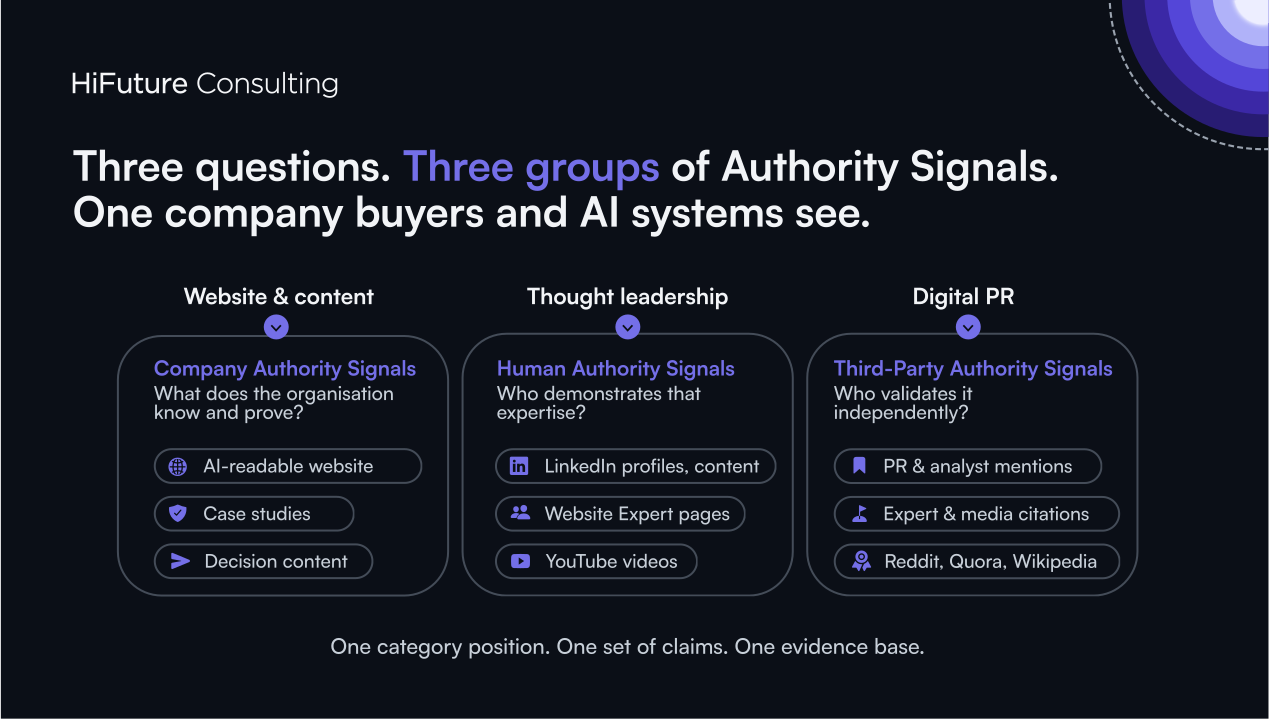
Figure 1. Three groups of authority signals shape AI visibility and buyer trust. Source: HiFuture Consulting, 2026.
Company Authority Signals: what the organisation knows and proves
Company Authority Signals cover the knowledge an organisation owns and publishes. That includes the website, case studies, methodologies, frameworks, research, decision content and other evidence. Their job is to make the company’s knowledge, capabilities and proof easy for buyers to understand and for AI systems to retrieve and interpret.
The amount of content matters less than its clarity. A marketing team should ask whether its owned knowledge makes it clear what the company knows, what it does and what it can prove.
Human Authority Signals: who demonstrates the expertise
Human Authority Signals come from executives, subject-matter experts and Sales professionals who make organisational expertise visible under their own names. They appear in LinkedIn posts and articles, on expert pages, in webinars, in video, on stage and in other public contributions.
For buyers, these signals add a human layer of credibility. For AI systems, they create more public evidence that connects people, topics, expertise and organisations. That is why HiFuture places thought leadership inside the company’s authority infrastructure, and why personal branding is too narrow a frame for it. Company knowledge shows what the organisation knows. Human Authority shows who knows it.
Third-Party Authority Signals: who validates it independently
Third-Party Authority Signals come from outside the company. They include customer evidence, partners, media, analysts, communities, citations and rankings. Buyers and AI systems both look beyond a company’s own channels before they trust its claims.
Independent signals reduce uncertainty and give the market more confidence in what the company says about itself.
Why is having all three groups of signals not enough?
A company can have strong content, credible experts and excellent media coverage and still leave a weak overall impression. That happens when the signals point in different directions.
Authority Orchestration™ addresses this. It connects what the company knows, what its people demonstrate and what the market independently validates, so that all of it reinforces one coherent market position across the buying journey.
Orchestration does not require every channel to repeat the same message, because consistency and sameness are different things. A CEO’s LinkedIn post, a customer case study and an analyst report will always sound different. What should stay constant is what the company wants to be known for, where its expertise sits and why that expertise is credible.
How do authority signals support both GTM battles?
Authority signals matter before a buyer makes contact and after it.
Before buyer intent becomes visible, the signals help a company move through four states: familiar, understood, shortlisted and preferred. This is GTM Battle 1, Win Shortlist and Early Preference. The stakes are high. In the 6sense 2025 B2B Buyer Experience Report, 95% of winning vendors were already on the buyer’s Day-One shortlist.
Once the buying process becomes visible, the same signals keep working. Marketing and Sales use them to bring the right knowledge, expertise, proof and independent validation into the buying group as the company becomes validated, endorsed and finally chosen. This is GTM Battle 2, Become Chosen.
The move between the two battles changes the scale of influence. Before contact, authority signals influence the market. After contact, they influence one specific account. Battle 1 sits mostly with Marketing, while Battle 2 belongs to Marketing and Sales together. A company that loses Battle 1 may never get a real chance to compete in Battle 2.
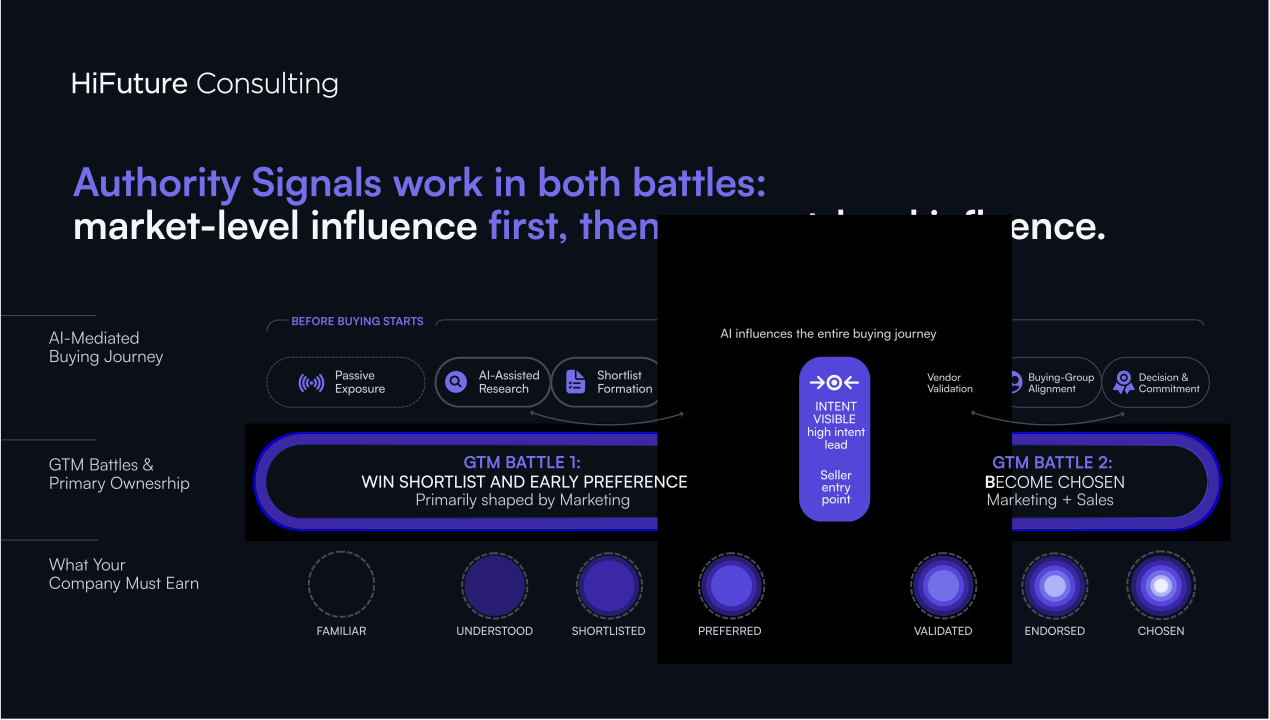
Figure 2. Authority signals build market-level influence before contact and account-level influence after it. Source: HiFuture Consulting, 2026.
What should CMOs do with the Authority Signals Model™?
The model changes how a CMO plans and measures authority. Three changes follow from it.
1. Manage authority across the whole organisation
Website, thought leadership, PR, customer proof, partners and Sales enablement often have different owners. Buyers and AI systems still encounter one company. The CMO needs a view of the combined picture these signals create and a way to check whether they reinforce the same market position, expertise and proof. Every channel can keep its own voice, as long as the authority system as a whole stays coherent.
2. Treat internal expertise as a corporate asset
Many organisations already have the expertise they need, and much of it stays invisible. The strategic question is which expertise the market should associate with the company, and through which people it should become visible. Thought leadership turns that expertise into Human Authority Signals. In the wider HiFuture model, Account-Based Social Selling then brings relevant sales expertise into specific buying relationships through LinkedIn and Sales Navigator.
3. Plan authority signals for both GTM battles
Authority has a different job at each stage of the buying journey. Before buyer intent is visible, it helps the company become familiar, understood, shortlisted and preferred. After engagement, it gives Marketing and Sales the proof, expertise and external validation the wider buying group needs to validate, endorse and choose the company. Authority signals should therefore be planned against the buying journey as well as against the content calendar.
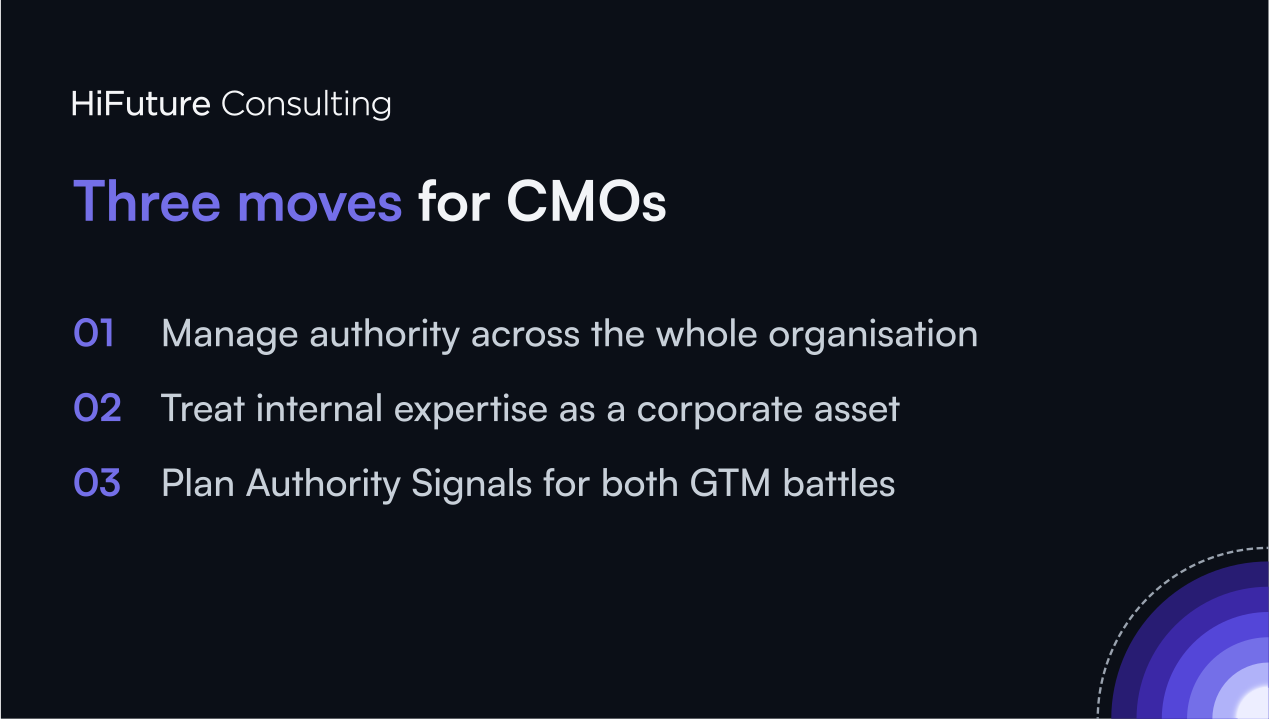
Figure 3. What the Authority Signals Model™ means for CMOs. Source: HiFuture Consulting, 2026.
How can a marketing team check its authority signals?
The questions below come straight from the model. They work best when the owners of each channel answer them together.
Company Authority Signals:
- Does our owned knowledge make it clear what we know, what we do and what we can prove?
- Can buyers and AI systems find our case studies, methodologies and decision content and understand them without our help?
Human Authority Signals:
- Which expertise should the market associate with us?
- Through which people should that expertise become visible?
Third-Party Authority Signals:
- Which independent sources validate what we claim today?
- Do customers, partners, media and analysts describe our expertise the way we describe it ourselves?
Across all three groups:
- Do our signals reinforce the same market position, areas of expertise and proof, or do they create conflicting versions of the company?
- Have we planned signals for both GTM battles, or only for the content calendar?
Frequently asked questions
What is the Authority Signals Model™?
The Authority Signals Model™ is HiFuture’s operating model for building organisational authority. It defines three groups of authority signals a B2B company needs: Company Authority Signals, Human Authority Signals and Third-Party Authority Signals.
What is the difference between Company and Human Authority Signals?
Company Authority Signals are created and owned by the organisation, such as its website, case studies and research. Human Authority Signals come from identifiable experts who represent the organisation’s expertise, such as executives, subject-matter experts and Sales professionals publishing under their own names.
How do authority signals affect AI visibility?
AI systems answer buyer questions with public evidence they can retrieve and attribute. Clear company knowledge, visible experts and independent validation give them consistent evidence about what a company knows and who stands behind that knowledge.
What is Authority Orchestration™?
Authority Orchestration™ is the strategic discipline of designing, connecting and activating authority signals as one consistent ecosystem across the buying journey. Its goal is a company that AI systems interpret accurately, buyers trust and prefer, and buying groups choose with confidence.
Where to start?
A company may already have strong knowledge, exceptional people and credible external proof. The question worth asking is whether those signals reinforce one another and help the company become understood, shortlisted, preferred and chosen.
If you want to see where your organisation has strong authority signals, where they are fragmented and what needs to be connected across Marketing, experts and external channels, we can go through it with you.
Sources
- Katarzyna Sitarska, Izabela Kwiatkowska, The Authority Signals Model™: Building Authority for AI Visibility and Buyer Trust (newsletter #3, The Orchestrated Authority, 25.09.2026)