Your company isn’t invisible to AI because it has poor content. It’s invisible because AI can’t interpret it.
Until recently, many B2B companies assumed that if they had a good website, published articles regularly, and showcased case studies, they were ready for the new era of search. Today, that assumption is no longer enough.
The problem is increasingly not that a company isn’t creating content.
The problem is that AI systems can’t properly find, understand, and associate that content with a specific brand, expert, or area of expertise.
This is a significant shift. In classic SEO, one could long focus primarily on page rankings and traffic. In the world of AI, one must think more broadly: about whether the content is machine-readable, whether the author is clearly identifiable, whether the page structure hinders interpretation, and whether the most important information is hidden in a format that models cannot read well.
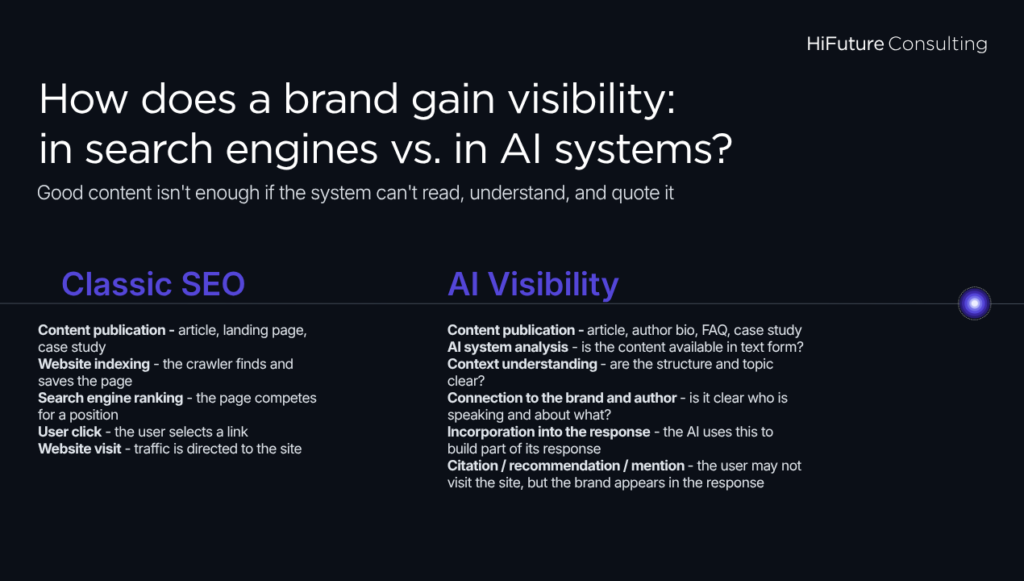
Good content isn’t enough if it isn’t accessible to AI
Many companies still evaluate their digital presence through a human lens. They check whether the website looks modern, whether the text is well-written, and whether everything displays properly on the screen. Meanwhile, an AI system doesn’t evaluate a website the same way a user does.
It isn’t interested in animations. An attractive layout doesn’t help it. It won’t guess who the author of an article is unless it’s clearly stated. It won’t correctly interpret the meaning of the content just because the brand “has a great image.”
AI needs much more literal things: text available in HTML, logical headings, a clear content hierarchy, a correct author description, sensible internal linking, and a structure that doesn’t force it to guess what a given subpage is actually about.
From this perspective, many B2B companies today don’t have a problem with content, but with its readability.
The website becomes the brand’s semantic layer
This is where we get to the heart of the matter. A website is no longer just a publishing platform. It becomes the brand’s semantic layer – an environment in which AI is supposed to recognize who you are, what you do, who speaks as an expert on your behalf, and which content deserves to be used in a response.
If a company publishes an expert article but does not identify the author, does not organize the headings, does not use structured data, and does not link the material to other content from the same expert domain, it makes it difficult for models to build an accurate picture of its brand.
In practice, this means that even highly substantive material may not contribute to visibility in AI. Not because it is poor, but simply because it was not prepared in a way that facilitates its understanding and citation.
“Making sure that important content is available in textual form.” – Google Search Central, AI Features and Your Website
A modern website may be user-friendly but unreadable to AI
This is one of the greatest paradoxes of the current transformation.
The more brands expand their front-end, the more elements they move to heavy frameworks, and the more information they hide in interactive modules, the more they impair their readability for AI systems.
For humans, such a website may be convenient and visually appealing. For a model, it may be incomplete, ambiguous, or too difficult to interpret in the time it takes to generate a response.
That’s why today it’s not enough to ask, “Do we have good content?”
We must ask:
- Is this content easy for robots to read?
- Is the most important information accessible without additional layers?
- Can the system understand who is speaking, what they are talking about, and why it is worth quoting?
Visibility in AI starts with organization, not with producing more content
In response to changing market behaviors, many companies opt for the simplest solution: publish more. More articles, more posts, more expert content. This is understandable, but often ineffective. If the AI system cannot correctly read existing content, adding more material only increases the chaos. The brand produces more, but this does not make it any more understandable.
It makes much more sense to start with a basic audit:
- are the key subpages actually text-accessible,
- are the authors clearly identified,
- do the articles have the correct structure,
- is the most important content not hidden behind solutions that make it difficult to read,
- does the site give the AI clear signals about categories, expertise, and connections between topics.
Only on such a foundation does content production begin to truly enhance AI Visibility.
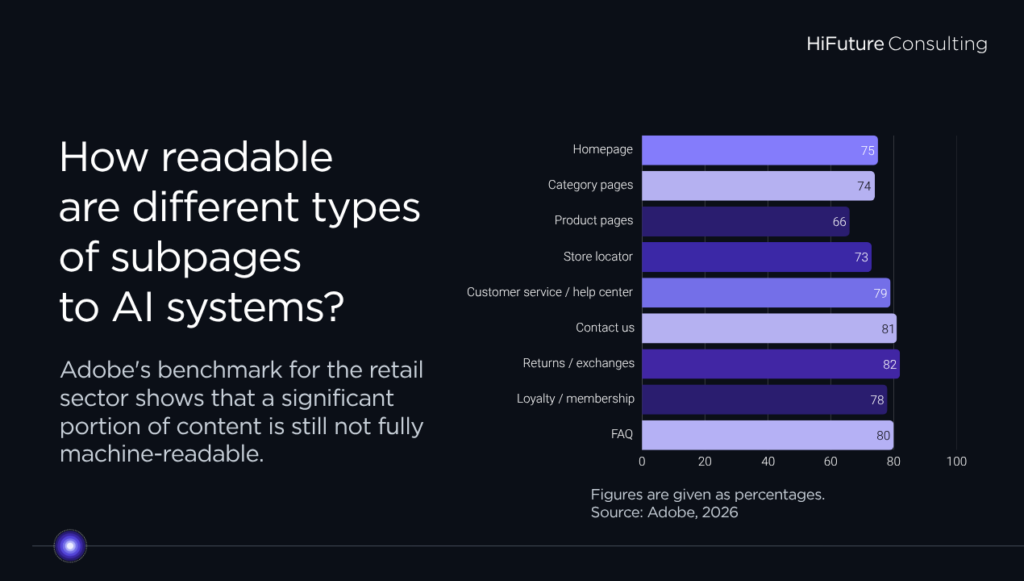
AI doesn’t need more content. It needs greater clarity
This is the most important takeaway for B2B companies.
In the new model, the advantage goes not to the company that publishes the most, but to the one that AI systems can understand most easily. The one that clearly communicates its areas of expertise, organizes its knowledge, highlights authors, and doesn’t force models to guess what’s truly important.
This shift has major implications for marketing. Content is no longer just a publishing tool. It becomes an element of Authority Architecture. It must not only be substantively sound but also unambiguous, recognizable, and technically ready for use by the systems that today act as intermediaries between the brand and the audience.
In this sense, AI Visibility is not a separate channel. It is a new quality test for a company’s entire digital presence.
“There are no additional technical requirements.” – Google Search Central
Executive Summary
Most B2B companies today don’t have a problem with a lack of content. Their problem is that AI systems can’t interpret it correctly. If a brand isn’t unambiguous, structured, and technically readable to models, even good content may fail to drive visibility. That’s why it’s becoming increasingly important not just to produce content, but to organize a company’s signals of expertise, credibility, and narrative into a coherent system that’s readable by both the market and AI. It is precisely this logic that underpins the proprietary HiFuture Authority Architecture (Signals) Model™ – the foundation of the Authority Signals Strategy, which helps transform content into a structured architecture of visibility, trust, and citability.
Sources:
Google Search Central, AI Features and Your Website https://developers.google.com/search/docs/appearance/ai-features
Google Search Central, Article structured data https://developers.google.com/search/docs/appearance/structured-data/article
OpenAI, Overview of OpenAI Crawlers
https://developers.openai.com/api/docs/bots
Cloudflare, Control content use for AI training with Cloudflare’s managed robots.txt https://blog.cloudflare.com/control-content-use-for-ai-training/
Adobe, AI traffic grows but retail sites lag in AI search visibility https://business.adobe.com/blog/ai-traffic-surge-retail-sites-not-machine-readable